
Residents defeat data center developer 2-1 as industry braces for nationwide opposition

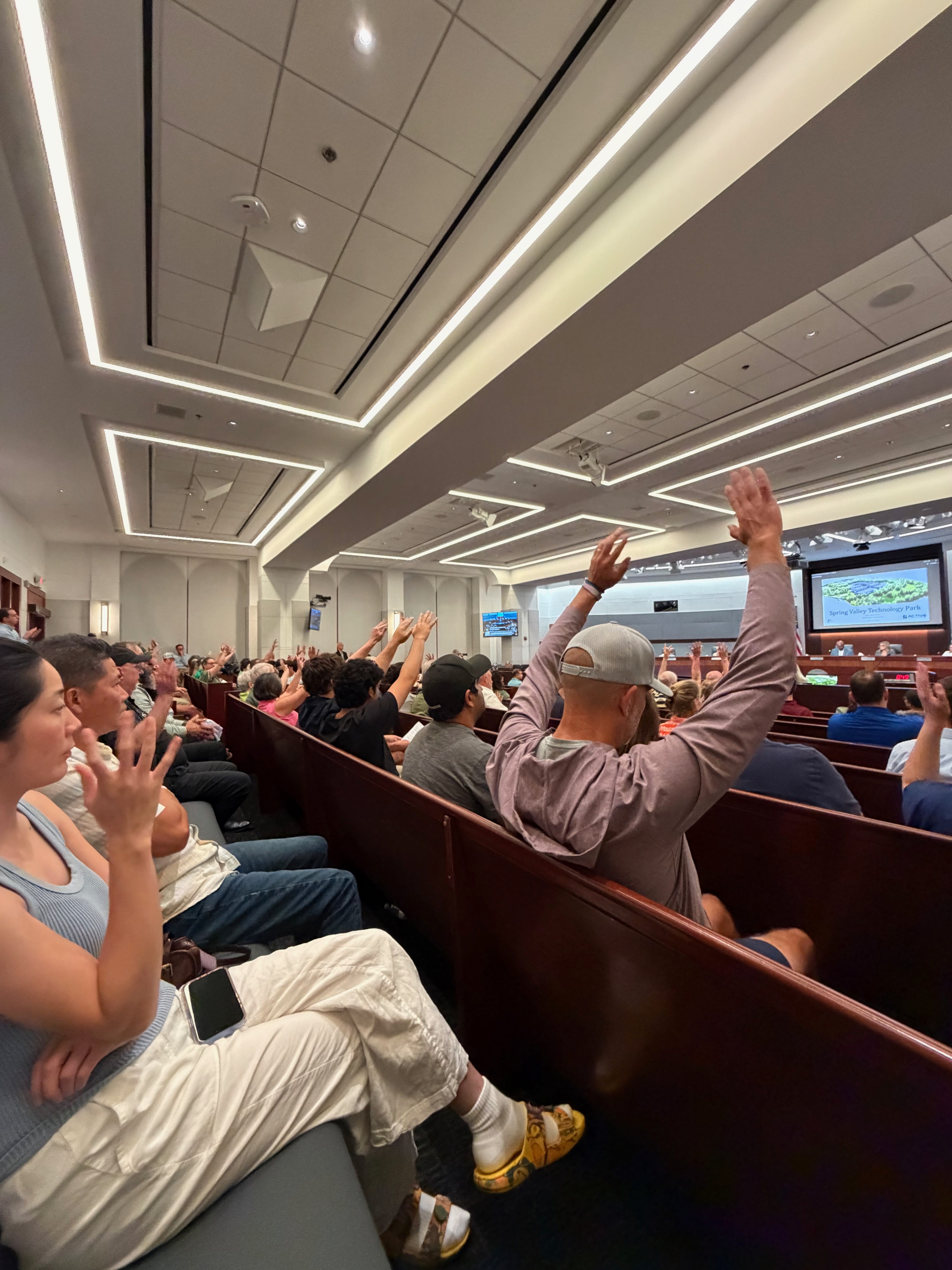
The Loudoun County Planning Commission dealt New York developer Active Infrastructure its second blow in six months last week when it voted 6-0-3 to recommend that the county board of supervisors deny their rezoning application. The application is unlikely to be approved by the board of supervisors. However, if approved, it would allow Active Infrastructure to build a 3.5-million-square foot data center, dubbed the Spring Valley Technology Park, on a 362-acre parcel of land, currently zoned for low-density housing.
More than sixty-two residents of all ages signed up to speak against the application. Only one person, representing the electrician’s union, spoke in favor arguing that data center construction creates jobs. The application will likely come before the board of supervisors in the fall.
Last December the Chandler, Arizona City Council voted to deny an application by Active Infrastructure to construct a data center, despite lobbying efforts by former U.S. Senator Krysten Sinema (I-AZ). The New York developer also owns land in Canton and Columbus, Ohio as well as elsewhere in Northern Virginia.
These are two of the many examples taking place not just in Virginia and Arizona, but across the country where communities are fighting back against data center construction and the infrastructure that comes with them such as high voltage power lines. Recent polling by the Data Center Opinion Project at the University of Virginia shows that 65% of Americans, across party lines, oppose data centers in their communities. Perhaps even more striking is that the issue has Democrats and Republicans using the same words such as, water, resources, power, environment, nature, noise, pollution and jobs when describing their opposition.
In response, the data center industry is pouring money into lobbying efforts. According to Open Secrets Amazon, Microsoft, Google, and Meta together spent tens of millions of dollars in federal lobbying in 2025.
This aggressive political spending at the federal level is part of an effort to mitigate risk. Last week the Wall Street Journal reported that the AI industry has already issued $270 billion in bonds so far in 2026 and says this is almost double what was raised in all of 2025. As data center opponents block and delay data center construction it increases the costs required to build. The headline for an article in Barron’s says it all, “Americans Hate AI Data Centers. For Stocks, the Trouble Is Just Beginning.”
Tom Wheeler, former FCC chairman and a visiting fellow in Governance Studies at Brookings neatly summarizes the industry’s fears:
“Fully aware of this challenge and that the local data center movement could metastasize to shape national AI policy, those financing and directing the development of AI have been loosening their purse strings to fund political activity. One of those, Leading the Future, a super PAC, was launched by industry luminaries, reportedly with $50 million from AI investor Andreessen Horowitz and $50 million from OpenAI’s president Greg Brockman. Thanks to deep pockets such as these, the PAC began with $140 million in its coffers for the purpose of “identifying, maintaining, and growing pro-AI candidates.”
Politico has referred to it the “Death Star”, and it is one of the 10 wealthiest and influential super PACS in the country. Federal Election Commission (FEC) filings show that as of June 30 Leading the Future has spent, through contributions to their democratic and republican war chests, Think Big and American Mission, nearly $25 million on house and senate primaries to elect pro-AI and data center candidates. Despite this level of spending, Leading the Future still had $31 million of cash in hand as of June 30. Think Big and American Mission collectively still had nearly $12 million.
This federal activity is trickling down to the state level. For example, Amazon arguably has the largest footprint in Virginia, with seven registered lobbyists and $415,822 of political contributions in 2025 including $197,789 to Democrats and $167,500 to Republicans. Google has 10 registered lobbyists in Virginia but only $125,000 contributions, Meta has one lobbyist and $33,500 in political contributions, and Microsoft has one lobbyist and no recorded political contributions for 2025.
The industry trade organization, the Data Center Coalition, headquartered in Leesburg, Virginia has five lobbyists, and made $225,500 in political contributions in 2025, $145,500 to Democrats and $76,000 to Republicans. In 2026 so far they have made $77,500 in contributions, $60,000 to Democrats and $16,000 to Republicans.
With the entire Loudoun County Board of Supervisors up for re-election in 2027, it remains to be seen if this trend will extend to local politics, because after all, when it comes right down to it, all politics is local.